
Grand Canyon National Park seeks public input on historic telephone line safety improvements
October 28, 2026
Grand Canyon National Park is seeking public comment on a proposal to remove hazardous sections of a historic telephone line that stretches through the inner canyon while preserving much of the infrastructure that has been part of the park's history for nearly a century.
The National Park Service has opened a 15-day public comment period, beginning Oct. 28 and continuing through midnight Nov. 11, on proposed safety improvements to the Trans-Canyon Telephone Line.
The historic line generally follows the Bright Angel and North Kaibab trails, with a spur extending toward the South Kaibab Trail. Reconstructed in 1935 by crews from the Civilian Conservation Corps, the line played an important role in communications and park operations.
It is listed on the National Register of Historic Places because of its significance to the park's communications, engineering and administrative history.
However, portions of the aging infrastructure have become safety hazards.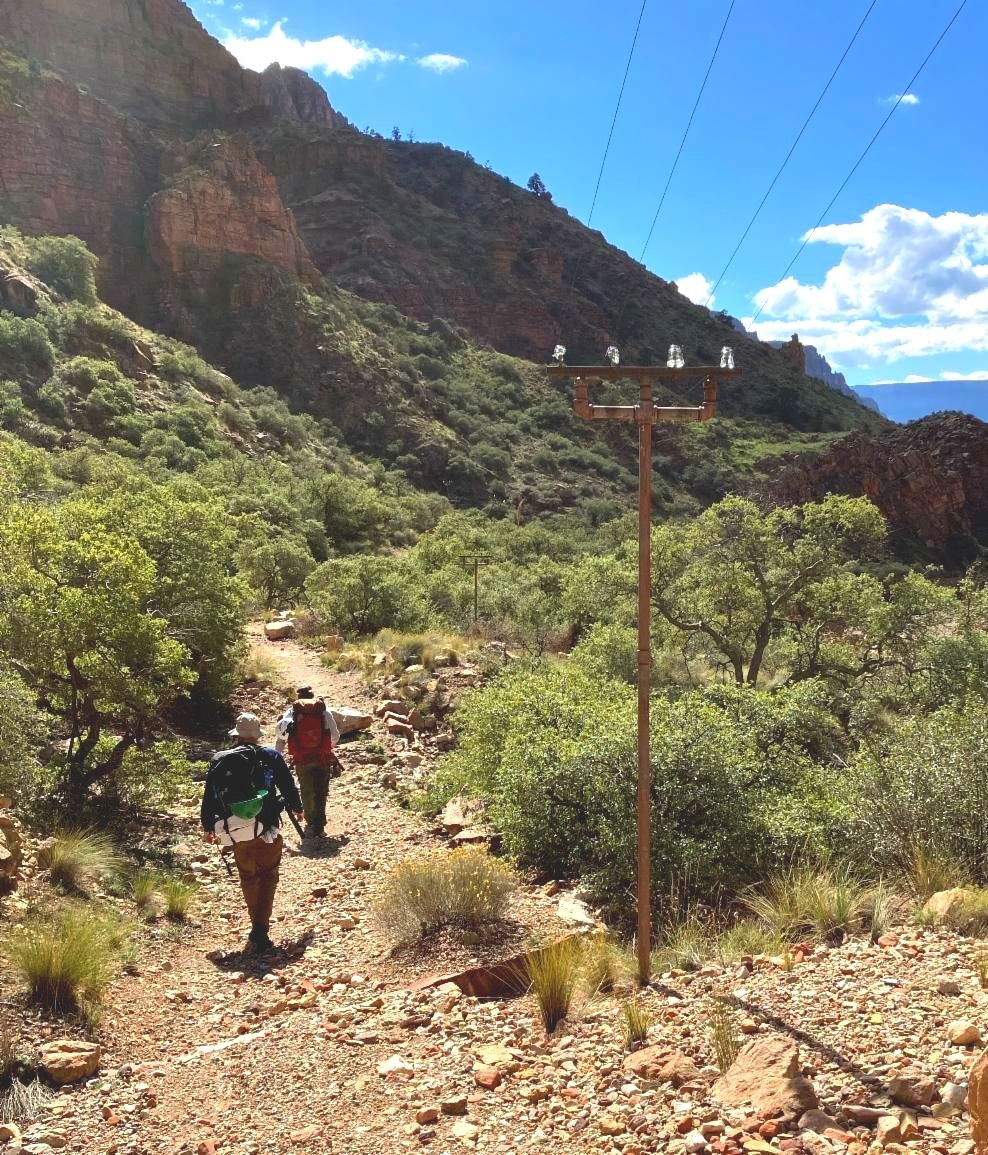
According to the National Park Service, suspended, hanging and fallen telephone wires pose risks to helicopter flights and emergency operations in the inner canyon. The wires can also create entanglement hazards for wildlife.
Under the proposed improvements, the park would remove sections of historic telephone wire where necessary to eliminate safety risks. Visibility markers would be installed on portions of the wire that remain in place.
Historic telephone poles, cross-arms, insulators and other equipment would generally be preserved unless they independently pose safety hazards.
The proposal presents a challenge for park officials because the original copper wire is considered an important part of the telephone line's historical significance.
The National Park Service has determined that removing sections of the wire and installing safety markers would alter characteristics that contribute to the property's historic designation. Under the National Historic Preservation Act, those changes are classified as an "adverse effect."
To address those concerns, the park has worked with the Arizona State Historic Preservation Officer to develop a draft Memorandum of Agreement outlining measures to preserve and document the line's historical significance while addressing safety concerns.
The agreement is intended to balance the need to protect helicopter crews, emergency responders and wildlife with the preservation of a historic resource.
How to comment
Residents and other interested parties can review the proposal and submit comments through the National Park Service's Planning, Environment, and Public Comment website.
Visitors should select the Grand Canyon National Park project involving the Trans-Canyon Telephone Line and follow the instructions under "Open for Comment."
Electronic submissions are the preferred method, and comments must be received by midnight Nov. 11.
The National Park Service cautions that comments become part of the public record and may be made publicly available, including any personal contact information submitted.

