
Grand Canyon flood leaves park under strict water restrictions as search continues. Tusayan Not Impacted
September 2, 2026
A deadly flash flood that damaged the water system serving Grand Canyon National Park has forced strict conservation measures on the South Rim, though water service in nearby Tusayan is not affected and facilities there remain open. The flood also killed two hikers and left another member of their group missing.
The National Park Service identified the hikers who died as John Giusti, 46, and Brent Rosenkranz, 42, both of Granbury, Texas. A third hiker from the group remains missing. Search crews are continuing efforts to locate the missing hiker and to account for anyone else who may have been in the affected area when the flood hit.
At a community meeting September 2nd , incident commander Brian Bloom told residents that 82 people had been rescued from the canyon. He said two people who were initially listed as missing had been recovered and one person remained missing. Crews have used helicopters, drones, ground teams and canine teams, while investigators have worked through more than 200 tips to determine whether anyone else may still be unaccounted for.
“There are no new unaccounted for people,” Bloom told the crowd, adding that the Western Incident Management Team was adding capacity, expertise and resources for a sustained response at the park.
The flood also caused major damage to the park’s water infrastructure. Adam Levy, the park’s facilities chief, told residents that roughly 40% of the Transcanyon Waterline between the North Rim and Phantom Ranch had some type of damage, ranging from severe damage to sections being completely gone. He said many bridges in the inner canyon corridor were damaged or washed away, five to seven miles of the North Kaibab Trail were lost or severely damaged, and both the Roaring Springs intake and the newer Bright Angel Creek intake sustained damage.
Levy said the South Rim’s tank farm was not empty but was drawing down because the system has not been pumping water since the flood. Full storage is 23.6 feet, he said, and tanks were at 21.08 feet the morning of the meeting. The system was losing about half a foot per day — roughly 250,000 gallons — even with overnight guests no longer staying inside the park.
“Every gallon we can save on the South Rim gives us the repair and recovery time that we’re going to need,” Levy said.
The park is now under Stage 4 water restrictions. AJ Lepre, Grand Canyon’s chief of interpretation and education, said overnight accommodations in park hotels and Trailer Village have been stopped. Mather Campground and Desert View Campground remain available only for dry camping, and visitors are limited to day use. Open fires and charcoal fires are also prohibited.
Residents are being asked to use tap water only for hygiene, sanitation, flushing and cleaning. Bottled drinking water is being distributed for drinking, cooking, brushing teeth, washing produce and caring for pets. Lepre urged residents to take short showers, capture water while waiting for it to warm, run only full loads of laundry or dishes, stop outdoor watering and report leaks.
Officials said they do not currently plan to shut off water to homes or facilities, but they are evaluating water access across the park and will communicate any additional actions if conditions change.
Deputy Superintendent Brian Drapeaux said park leaders want to keep the community intact while continuing to provide access to the national park for day visitors. He said the park is exploring ways to bring in water, but outside water cannot simply be added to the system because the park’s water and wastewater operations are regulated by the Arizona Department of Environmental Quality.
Drapeaux said the park has an evacuation plan for disasters and would continue planning with concessionaires, government partners and community organizations if water reserves reach critical levels. He did not provide a specific evacuation threshold or timeline.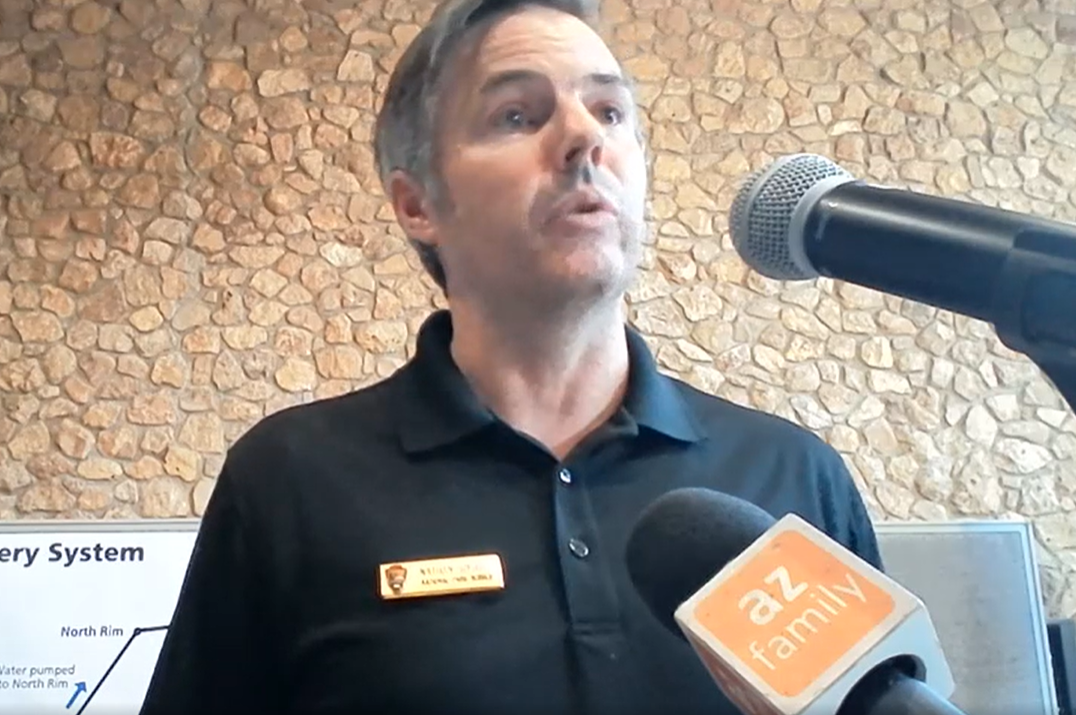
Nathan Souder (pictured), the liaison officer for the incident management team, said community support needs to be coordinated through approved channels. He pointed residents to the American Red Cross for mental health and spiritual care support and to the Grand Canyon Community Food Pantry for donations and assistance.
Park officials said residents should sign up for Everbridge alerts and the park’s news distribution system for updates on drinking water pickup locations, restrictions and recovery plans. Water service in Tusayan is not affected, and facilities in the town remain open.

